
Elemental Monsters: Merge
Go DreamsStrategy
4.8279.00 Reviews
- Version
- 2.8.9
- Installs
- 1.00M
- Age Rating
- Everyone
Screenshots

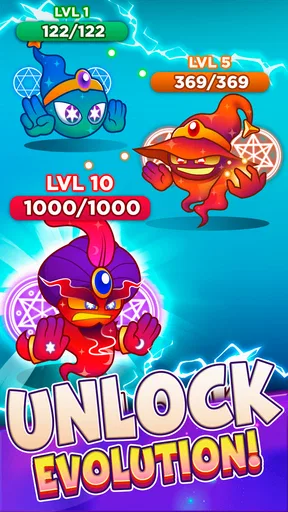


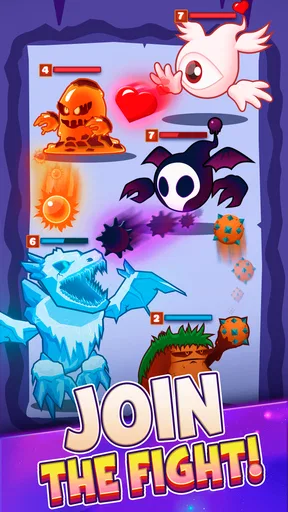

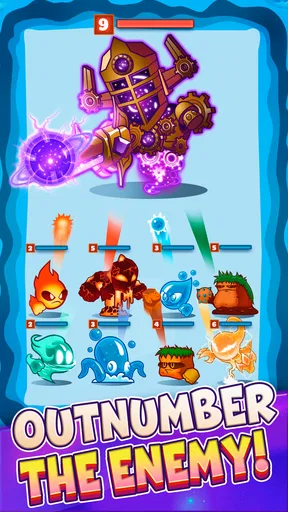
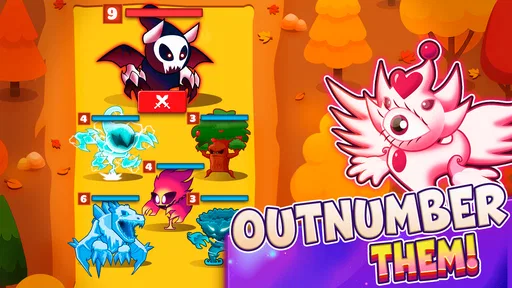
Our Review of Elemental Monsters: Merge
 Analysis by Appyee
I approached Elemental Monsters: Merge expecting a light strategy game built around combining creatures, but I found a more deliberate loop than the short store description suggests. The central idea is easy to understand: work with fire, water, earth, and air, evolve monsters, and take them into player-versus-environment duels. What makes it interesting is the small amount of planning between those actions. A merge is not just a tap that makes the board look better; it changes what I can bring into the next fight and how I use my limited attention.
That makes this a good fit for someone who enjoys short tactical decisions rather than a long, complicated strategy interface. I can open it for a quick session, make progress, and leave without needing to study a huge technology tree. At the same time, careless merging can leave me with a weaker set of options than I expected. My overall impression is that Go Dreams has built a friendly entry point into elemental strategy, although players looking for deep competitive systems or a very large collection of modes may eventually want something more demanding.
How the everyday merge-and-duel loop feels
My usual workflow starts with checking what creatures and elemental combinations are available before immediately merging anything. That pause matters. The most satisfying moments come when I treat the board as a preparation space instead of a place to clear as quickly as possible. I look for a merge that improves a creature I am likely to use, then consider whether the result gives me a better answer for the next PvE duel. This simple habit prevents the game from becoming a string of automatic taps.
The four-element theme gives the decisions a readable shape. Fire, water, earth, and air are easy to remember, so I do not need to learn an intimidating vocabulary before I can make sensible choices. The creatures give that framework more personality, while evolution provides a clear reason to keep experimenting. I enjoy that the game communicates its basic purpose quickly: combine, improve, and test the result in battle. It is approachable without feeling completely mindless.
In a realistic everyday situation, I would play a few rounds while waiting for an appointment or during a short break. I can review the current creatures, make one or two careful merges, and enter a duel without committing to a long uninterrupted session. That convenience is one of the strongest reasons I would recommend it to casual strategy players. It does not demand the same kind of sustained concentration as a large turn-based campaign, but it still gives each small action a consequence.
The PvE focus also affects how I think about failure. I am not trying to outguess a human opponent who has studied the same system; I am trying to understand what my current collection can handle. That makes experimentation less stressful. If a combination does not perform well, I can adjust the next attempt instead of feeling that one poor decision has ruined a competitive ranking. For younger players and families, the Everyone content rating supports the game’s accessible presentation, though adults should still remember that optional purchases are present.
The free entry point is helpful because I can test the core loop before deciding whether it deserves regular space on my phone. The game has a 4.8 average from around 65 thousand ratings, and it has passed one million installs, so there is clearly broad interest in this particular style of elemental creature strategy. Those figures do not replace personal experience, but they do suggest that the concept is easy for many players to pick up. I found the appeal understandable: the theme is clear, the actions are compact, and evolution creates a visible sense of progress.
What I check before spending resources
One of my most useful habits is to separate “interesting” from “useful.” A new creature or evolved form can be exciting, but I do not automatically treat every improvement as the best next move. Before merging, I ask whether the result strengthens a lineup I already understand or simply consumes pieces that might have helped me build a different option. This is especially important when I am still learning how elemental choices affect my duels.
I also avoid merging just to remove clutter. That is a tempting instinct in any merge game, but here the board is connected to tactical preparation. If I combine everything as soon as possible, I may end up with fewer flexible choices when I reach a fight. Keeping a small reserve can be more valuable than producing the most advanced-looking creature immediately. I do not need to preserve every item forever; I simply want to know why I am using each one.
Another practical check is whether I am preparing for a specific duel or building generally. For a known challenge, I favor a focused plan and try to improve the creature or elemental direction that supports it. When I am playing without a particular target, I am more willing to test unusual combinations. Switching between those two mindsets keeps the merge board from becoming repetitive and helps me learn through controlled mistakes.
Settings and small habits that improve the experience
I recommend checking the game’s available settings as soon as it is installed, especially sound and notification controls if those options appear on the device. I prefer to decide whether audio belongs in a short public-session game rather than discovering it in a waiting room. Keeping the interface comfortable is not a tactical advantage, but it makes repeated sessions less tiring and helps the game fit around daily life.
I also pay attention to how quickly I tap. Fast play feels natural when the next action is obvious, but it is exactly when I am most likely to merge something I intended to keep. I use a slower rhythm during collection management and speed up only after I have confirmed the target. This is a simple shortcut created by habit rather than by a special button: inspect first, merge second, duel third.
For players using older devices, compatibility is reasonably broad because the minimum operating-system requirement is Android 7.0. That does not guarantee identical performance on every phone, so I would still watch for heat, battery use, or sluggish touch response during a longer session. If the game feels uncomfortable at a particular pace, shorter sessions are preferable to forcing it into a marathon. The current version is 2.8.9, which is useful context when checking whether the installed build is up to date.
The purchase structure deserves a clear look before anyone hands the phone to a child. The game is free to start, while individual in-app items range from $0.49 to $99.99. I would set a device-level purchase safeguard and explain that “free” describes access to the game, not the absence of optional spending. For me, the best approach is to play the opening loop without buying anything, decide whether the progression itself is enjoyable, and only then consider whether a purchase solves a real frustration rather than an impulse.
Faster patterns that do not sacrifice planning
The fastest reliable pattern I found is to create a repeatable inspection order. I start with the creatures that are closest to a useful evolution, then review the elemental direction I want for the next duel, and only afterward consider spare pieces. This avoids scanning the whole collection from scratch every time. It also makes my decisions easier to reproduce when I return later and cannot remember exactly what I was building.
I use a second pattern for uncertain battles: make one meaningful improvement, test it in PvE, and use the result to guide the next merge. That is better than spending every available resource before learning whether the plan works. The game’s accessible structure makes this kind of small experiment practical. I can treat a duel as feedback rather than merely as a pass-or-fail checkpoint.
When I have several possible merges, I favor the one that gives me the clearest next decision. A result that leaves me with understandable options is often more valuable than a result that looks stronger but makes the rest of the board awkward. This is a subtle trade-off that store summaries do not explain: progress is not only about reaching a higher creature; it is also about preserving a manageable route toward the next useful choice.
I would not recommend trying to optimize every move from the first minute. The elemental theme is approachable precisely because I can learn by playing. Instead, I keep a mental note of combinations that worked, combinations that felt inefficient, and situations where saving a piece helped later. Over time, those observations become a personal shortcut. I spend less time hesitating, but I do not turn the game into an automatic routine.
Another helpful workflow is to stop after a clear objective. If I have completed a duel and made the planned evolution, I often leave the game there rather than continuing to merge without a purpose. This protects the quality of my decisions and makes the next session feel fresh. It also suits the game’s short-session character better than trying to force constant progress.
Where the strategy becomes less satisfying
The main limitation is that the simplicity that makes Elemental Monsters: Merge welcoming can also make it feel light for experienced strategy fans. The four-element framework is easy to grasp, but players who want a dense system of counters, elaborate formations, or extensive long-term planning may find the decision space narrower than in a traditional strategy title. I enjoy the clarity, yet I would not choose this as my only strategy game if I wanted a deep tactical campaign.
The merge structure can also encourage repetitive behavior. Once I understand the immediate goal, some actions may feel more like maintenance than discovery. My solution is to set a specific purpose for each session, but that does not remove the underlying limitation. If you dislike repeating collection tasks or prefer constant novelty, the game may lose its appeal sooner than a strategy game with a wider range of scenarios.
There is a similar trade-off in the PvE format. Fighting computer-controlled opponents is comfortable and approachable, especially when I want to experiment without social pressure. However, it does not offer the unpredictable adaptation of a human rival. Players who are motivated by live competition, ranking tension, or direct mind games should look toward a strategy game designed around those experiences instead.
The purchase range is another point I would handle carefully. The free download lowers the barrier to trying the game, but the presence of items reaching $99.99 means families should not treat it as automatically cost-free. I would be happiest playing it as a free casual game and judging purchases strictly by whether they add enjoyment. Anyone who prefers a single upfront price with no optional spending may be more comfortable elsewhere.
I also think the game is better for players who enjoy gradual improvement than for people seeking a complete challenge in one sitting. Its appeal comes from returning, refining a creature plan, and seeing whether a better merge changes the next duel. If that rhythm sounds satisfying, the modest scope works in its favor. If you need a dramatic story, a large world, or a long list of distinct modes, the elemental theme alone may not carry the experience.
Who should install it and who should skip it
I would recommend it to casual strategy players, fans of creature evolution, and anyone who likes merge mechanics with a clear battle purpose. It is particularly suitable for someone who wants decisions that are understandable within a few minutes but still appreciates the option to improve through better timing and resource choices. The Everyone rating also makes its presentation broadly approachable, although purchase controls remain important for shared devices.
I would be more cautious recommending it to players who need highly competitive depth. The game’s strength is its clean elemental loop, not an overwhelming number of systems. Likewise, people who dislike free-to-play structures should think carefully before installing, even if they never spend. The purchase range means the surrounding store model may be more noticeable to some users than the core strategy.
Compared with a typical match-three game, this has a stronger sense of direction because merges feed into creatures and duels rather than ending as a score-clearing exercise. Compared with a full creature-collection RPG, it is easier to enter and less demanding, but it also offers less room for elaborate team building and narrative investment. Against a traditional strategy game, it is quicker and friendlier, though not as rich in long-term tactical complexity. That middle position is exactly why I can see it working well as a secondary game on a phone.
My verdict after building a repeatable routine
After settling into the inspect, merge, duel, and review rhythm, I found Elemental Monsters: Merge more enjoyable than I expected from its compact concept. The best part is not simply watching creatures evolve; it is learning when an evolution is genuinely useful and when patience produces a better next move. Fire, water, earth, and air give the game an immediately readable identity, while PvE duels provide a reason to keep refining the collection.
My advice is to play deliberately at first, check the settings for a comfortable session, protect purchases on shared devices, and avoid merging merely to clear space. Those habits reveal the strategy that is there without pretending the game is deeper than it is. The developer, Go Dreams, has aimed this experience at accessibility, and I think that choice succeeds more often than it fails.
Released on March 13, 2025, and available free of charge, it is an easy recommendation for a short-session player who wants elemental creatures and light tactical planning. I would skip it only if I needed live competition, a substantial story, or a completely purchase-free structure. For everyone else, it is a pleasant, focused game that rewards attention without demanding a serious time commitment. Its real strength is the balance between quick progress and small decisions that still matter.
Verdict
Strengths of Elemental Monsters: Merge
- Simple merge mechanics are easy to learn and play casually.
- Monster collection gives progression beyond individual merge sessions.
- Short play sessions work well for quick breaks.
- Bright elemental designs make the creatures easy to recognize.
- The game offers a relaxing pace without demanding fast reactions.
Limitations of Elemental Monsters: Merge
- Repeated merging can become monotonous after extended play.
- Higher-level monsters may require considerable time to unlock.
- Progress can feel slow without frequent gameplay sessions.
- The small screen can make crowded boards harder to manage.
- Some features may be limited unless optional purchases are made.
Other Releases by Go Dreams
View All
Bunker: Zombie Survival Games
Adventure4.3

Drone App: Forecast for UAV
Weather4.3

Cellular Tower - Signal Finder
Maps & Navigation4.4
Similar Picks in This Category
View All
Clash of Clans
Supercell4.5

Plants vs. Zombies™
ELECTRONIC ARTS3.7

Lords Mobile: Kingdom Wars
IGG.COM4.5

Clash Royale
Supercell4.4

State.io — Conquer the World
CASUAL AZUR GAMES4.1

Car Driving School : Car Games
Spark Game Studios3.9
Frequently Asked Questions
What is Elemental Monsters: Merge?
Elemental Monsters: Merge is a casual puzzle and monster-collection game centered on combining creatures and elemental powers. Players merge matching monsters or items to create stronger forms, unlock new content, and progress through increasingly challenging stages. Its simple controls make it easy to start, while the collection and upgrade systems provide longer-term goals for players who enjoy relaxed progression.
How do you play Elemental Monsters: Merge?
Gameplay generally revolves around placing, combining, and upgrading matching elemental monsters or objects. Successful merges produce more powerful units, which can help clear objectives, defeat opponents, or complete level requirements. Before merging, it is useful to consider the available space and the order of combinations, because careless moves can leave the board crowded and make later objectives more difficult to finish.
Is Elemental Monsters: Merge free to download and play?
Elemental Monsters: Merge can typically be downloaded and played without an upfront purchase, although the free version may include advertising, optional in-app purchases, or both. These purchases may provide extra resources, boosts, or faster progression. You should review the store listing and your device’s purchase settings before playing, especially if children use the device or share the same payment account.
Can Elemental Monsters: Merge be played offline?
Some basic merging activities may work without a permanent internet connection, but online access can still be required for advertisements, cloud saving, events, updates, account features, or purchases. Offline behavior may also vary between Android and iOS versions. If you plan to play while traveling, test the game without Wi-Fi or mobile data first so you know which features remain available.
Is Elemental Monsters: Merge suitable for children?
The game’s colorful presentation and straightforward puzzle mechanics may appeal to younger players, but parents should check the current age rating, advertising policy, and in-app purchase options before installation. Some versions may display third-party advertisements or encourage optional spending. Parental controls, purchase restrictions, and play-time limits are recommended if children will be using the application regularly.
Play our best games!


